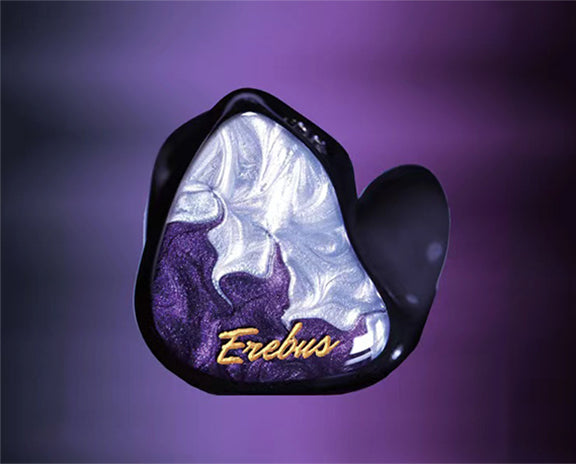
NGaudio Erebus


Erebus is a way-under-the-radar (in the West at least) TOTL IEM, with an overall performance paralleling or besting many other legends such as Traillii and more. Here are some of my impressions about this fantastic IEM, excerpted from my Head-Fi review of Erebus:
It has a premium build. The Erebus shell feels like a small piece of polished marble. The plate design is not super attractive, and I never would have chosen this on looks alone. Erebus has a more comfortable than any other IEM I have tried except Fei Wan. I could have Erebus in all day and barely notice.
Erebus has a relatively relaxed sound, but it has some verve, scales extremely well, works with just about any type of music, for any mood I brought to it.
It features a largely uncolored, very slightly warm, reference-ish sound (its bass strength and upper mids energy keep it from being what I imagine truly reference style to be).
At first it does not sound really special, rather just very good, but with more extended listening, the full scope of how impressive and top-shelf Erebus is becomes clear.
Erebus features a balanced W shaped sound. All parts of the FR are distinct and still coherent, unlike some other W shaped IEMs like Rn6 that to me sounded slightly less coherent.
Erebus’ sub bass has punch and snap, and is articulate and tactile.
There is a medium amount of mid bass that comes up to lower mids just enough to bring them a bit forward and add depth and a little warmth. No muddiness across the spectrum.
Erebus’ mids provide just the right amount for vocals and acoustic instruments to assert their space well and not be left behind, as can be the case with Loki in particular. Erebus’ mids are neutral-ish but still have excellent texture. To go beyond the set of four in these impressions, and going from memory, I find Erebus' mids not to be as warm and romantic as Trailli's. I find its mids however to be as detailed and similar-charactered as Mentor's.
The upper mids can be energetic at times, though not peaky and generally not fatiguing. This quality lends urgency to many vocals, which 90% of the time is welcome. Still, I would prefer it was dialed down. At points the danger zone is approached, but never fully entered into thankfully.
Erebus has fantastic treble, not dry but rather neutral to slightly sweet, loads of air with just the right sparkle, softened crispness, medium extension, zero sibilance, not at all fatiguing. Very close to Annihilator 23’s class-leading treble, I would say 95% of it, just lacking a very slight bit of the superior transient snap that Anni possesses.
Erebus provides a largely neutral sound, slightly warm with minimal color. It presents music how was intended perhaps (as overused an expression as that is).
Superb technicals, right up there with the very best as an entire presentation.
Excellent layering and separation of instruments, better than the other three, in spite of their excellence. Superior imaging as well.
Compares to other staging class leaders like Fei Wan, Traillii, and Mentor, which has massive 360 holographic staging, more than Erebus.
Dynamics are solid but Fei Wan is a dynamics monster, and Erebus isn't quite at that level. It is on par with Anni and Loki's dynamics performance.
Excellent detailed transients, particularly acoustic and brass instruments. Overall top-shelf resolution, as well as speed and dynamics.
Maybe the best part of Erebus’ performance is with vocal-focused music. Up and down vocal ranges, it scales so well, so many Wow moments. All across the vocal spectrum, I hear excellence of pacing, timbre, intonation, detail.
Best music genres for Erebus: All of them! (or at least all the genres I listen to). Jazz and bass vocal sound superb. Classic rock, modern rock, pop, dance pop: all excellent. I suspect classical would sound terrific, though I don’t listen to it. Live music sounds fantastic, spacious, holographic, dynamic.
Erebus is a bit of a slow burn as far as recognizing its amazing qualities. After a handful of listening sessions of "this is good but not great" and allowing Erebus to burn in, it became very evident what a special IEM this is. Erebus rewards patience, but not too much is required.
I can find only a few flaws for my preferences. One would be the plate design, not a big deal for me but still it is not attractive. The lack of recessed 2-pin connector ports is not great. It is expensive at $4700US retail. The other nitpick is the energy in the upper mids, which if they were slightly reduced would make this the IEM I could quit the hobby with. Even still, it very well could be if that sad day were ever to come.
Hopefully more people will get to hear Erebus. It is first-rate and should be in the conversation when we all debate which are the TOTL of TOTLs in the IEM world.

The A&O Omega is a beautiful piece of art. The design, the premium drivers, the cable…all top notch. In today’s day and age, an IEM this special under $3k is significant. Before I get too far into this, it is best to throw a neutral/natural source at the Omega. Something overly warm will leave you missing the higher-end technicalities that it can produce. While it doesn’t HAVE to have a lot of power, something that gives plenty of headroom will benefit the Omega, and your listening enjoyment. Basically, just remember that synergy is king…doesn’t always have to be the most expensive source kit to get the most out of a higher end IEM.
The tonality is full, with a warm tilt. I hear no edginess or sibilance regardless of where the switches are. The bass is just spectacular. If you, like me, had a romantic inclination towards something like the Legend X (or Evo), this is a wonderful upgrade from that general category of sound signature. It evokes the same emotion to me as the X did back in the day. I’ve had the chance to trade with friends a couple of times and just can’t imagine enjoying anything more without breaking my bank with the Fulgrim. Don’t hesitate to give the Omega a try.
When the jack stopped working on my wm1a I wanted something small but still with natural musical timbre. I had the W4, which was very resolving and great in its own way. I decided to try the ru7. I think it's great and has the kind of sound I was looking for. It really is a kind of synthesis in sound between the w4 and wm1a.
The Canpur CP752B is nothing short of a revelation in the "summit-fi" landscape, effectively redefining what a flagship multiverse-driver IEM can do. The first thing that grabs you is the sheer scale of the soundstage—it is genuinely holographic. Where other IEMs might give you width, the CP752B uses its dual bone conduction drivers to create a 3D bubble that feels less like listening to earphones and more like sitting in a properly treated listening room. The separation is surgical without being sterile; you can pick out every layer of a complex track, yet the drivers—despite being a mix of BA, EST, Planar, and BC—blend with a coherence that is almost impossible to find in other "quadbrid" sets.
Tonally, these strike a brilliant balance that many are calling a refined "W-shape," bringing the best of all worlds. The bass is authoritative and massive, providing that visceral, textured rumble you usually only get from dynamic drivers, yet it retains the lightning-fast speed of balanced armatures. It hits with a weight that provides a solid foundation for the music without bleeding into the mids. Vocals are pushed forward just enough to be intimate and engaging, avoiding that distant "scooped" feeling, while the treble offers that elusive "sparkle without pain"—delivering immense air and micro-detail that extends forever without ever becoming sharp or fatiguing.
Finally, the build and package cement its status as an endgame monitor. The medical-grade resin shells are surprisingly comfortable for the driver count, and the collaboration with Eletech for the stock cable shows Canpur didn’t cut any corners. It is rare to find an IEM that manages to be both a technical monster and musically "fun" at the same time, but the CP752B pulls it off effortlessly. If you are looking for an IEM that competes with (and often wallops) sets costing significantly more, this is absolutely the one to beat.
The Epitome of the "Sophisticated Basshead" Monitor
Sound Signature Overview The Alpha & Omega Fulgrim can be best described as a "sophisticated basshead" audiophile monitor. It offers a masterclass in dynamic control, distinguishing itself by knowing exactly when to exhibit restraint and when to unleash power. Unlike typical bass-heavy IEMs that apply a blanket boost across the spectrum, the Fulgrim respects the mix; if a track demands neutrality, the low end remains disciplined. However, when the composition calls for it, the bass response is authoritative, visceral, and commanding.
Frequency Response Breakdown
Bass (The Foundation): With the stock Aura cable, the tuning exhibits a distinct bias toward the sub-bass region. The quality here is exceptional—highly textured, detailed, and deeply impactful. Crucially, despite the sheer quantity of low-end energy available, the tuning is meticulous; the bass creates a solid floor without ever bleeding into or muddying the lower mid-range.
Mid-Range (The Vocal Presence): Because of the clean separation from the bass, the mids are left uncolored and pristine. Vocals, both male and female, are rendered with clarity and high-resolution detail, ensuring the emotional core of the music is never lost behind the low-end drive.
Treble (The Resolution): The top end is characterized by excellent extension and a palpable sense of "air." Utilizing a configuration of 6 Electrostatic (EST) drivers, the Fulgrim achieves a transient response that is both resolving and authoritative. This technical capability ensures that no matter how thunderous the bass becomes, the treble remains distinct, piercing through the mix to reveal micro-details and atmospheric cues.
Technical Performance & Separation One of the Fulgrim’s standout technical achievements is its frequency separation. The three primary zones—Bass, Mids, and Treble—operate in distinct layers. There is no incoherent overlap or masking; the listener receives a holographic presentation where powerful lows and sparkling highs coexist without competing for acoustic space.
Synergy & Cable Pairing While the stock configuration provides a thrilling ride, those with a sensitivity to high-frequency energy may find the treble energetic. For these listeners, I strongly recommend pairing the Fulgrim with the Astral Acoustics "Luna" upgrade cable. This pairing introduces a subtle warmth that smooths out the sharper edges of the treble response while maintaining the IEM's inherent resolving capabilities, offering a more organic listen without sacrificing detail.
Verdict The Alpha & Omega Fulgrim is a rare beast: a monitor capable of satisfying the cravings of a basshead while maintaining the technical prowess required by a critical listener. Its ability to handle 99% of music genres with agility makes it a versatile endgame solution for those who want power without compromising on clarity.
The rumble in the bass when the bone conduction works properly and the holographic soundstage... I got spooked when I heard a bird chirping behind me and turned back only to find out it was from the song.