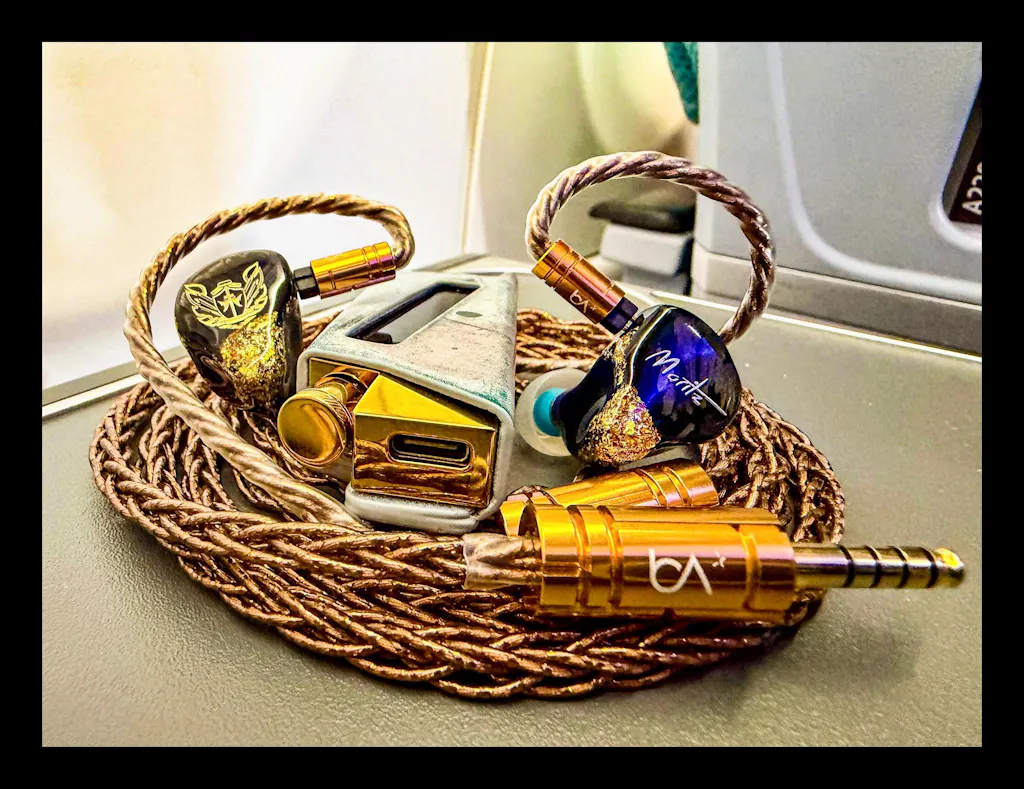
Lotoo PAW 6000 Reference Grade Portable Audio Player


This is the second lotoo paw 6000 I have purchased from you. Needless to say I would give this portable unit 10 stars if I could. It does everything that I needed to do long battery life exceptional sound in all the categories.
Lightning fast UI and naturally resolving sound with good dynamics...never been happier with my DAP choice! USB DAC is very useful too! Thanks MusicTeck for the recommendation on this one.
Andrew was a pleasure to work with, helping me find a dap that worked with my needs and met my budget. I am very happy with the Lotoo PAW 6000! It is quick and easy to use, and it sounds excellent. The build quality is top notch and it sounds much cleaner than my go blu I was using before and has a dead silent (black) background. The Eq is easy to use in my opinion and a lot of fun. The bluetooth has worked great for me the odd time I want to stream so no complaints there either. If you don't need streaming capabilities I think you would be hard pressed to find a better dap without paying 2 to 3 times the money. The paw 6000 is an easy 5 stars and I would recommend it to anyone looking for a standalone dap.
I got the PAW 6000 to replace my MK1 Lotoo 5000 that finally gave up the ghost, after 6+ years of heavy use. ( actually still very functional, battery gave up, so wont hold charge) - And actually was just thinking of a replacement 5000, upgrading to the current version, as the quirky UI, I was used to, and the sound I was more than happy with.
But then started thinking about maybe an audio upgrade while at it. I looked at the Paw 6000 as this seems to be gathering great reviews, and my pockets definitely have bottoms in, so have a budget, and the paw 6000 , on top of the stella performance and quality accolades, seems to be a great value unit, plus Musictech seemed to offer the very best price I was able to find, so I contacted Andrew, and bit the bullet.
And extremely happy with the player, very intuitive, and customizable, and sounds beautiful, and a solid feeling unit I can easily see keeping me happy for many years. The whole experience, was fantastic, even my concerns of shipping to Canada were settled, Incredibly fast, reasonable postage. So if considering the PAW 6000, or even Misictech, Id recommend both in a heart beat.
First, GREAT service and fast shipping, no-nonsense customs - Thank you Grace!
The Lotoo PAW 6000 is an excellent value all around! I've had several A&K's, Sony WM1A &1Z, Sony ZX507, Fiio's.,.. overall sound quality and OS speed, battery life make this easily the best value under 2K, in my opinion. The quality of your files (flac or dsd) and the right IEMs or headphones also make the difference, as with any.
Really happy with this purchase, recommend it over A&K, Sony, and Fiio. As soon as I discovered Lotto is a big brand overseas that produces various pro-audio and related items, as well as being the producer of the (legendary) PAW Gold/Touch I decided to try my luck.
So--- A++ build quality, FAST OS (and so easy), great battery life, GREAT EQ! (Spend time with the EQ - it is very configurable), Excellent sound quality (++ better than the AK Cube imo), Gain works great, LINE Out is a plus. I can plug it into my Carver M I AMP with the 4.4 line-out... background and spaces between tracs are just as black as with iem's - never had that with any other DAP.
Received January 31, today is February 4 - ~30 hours on this player already - excellent! I may go for the Gold/Touch soon, if it's that much better than the P6000 I'd guess it is the Reference Player of all.
Lotoo P6000 - CA Andromeda's - Sony Kimber balanced 4.4 cable

When the jack stopped working on my wm1a I wanted something small but still with natural musical timbre. I had the W4, which was very resolving and great in its own way. I decided to try the ru7. I think it's great and has the kind of sound I was looking for. It really is a kind of synthesis in sound between the w4 and wm1a.
The Canpur CP752B is nothing short of a revelation in the "summit-fi" landscape, effectively redefining what a flagship multiverse-driver IEM can do. The first thing that grabs you is the sheer scale of the soundstage—it is genuinely holographic. Where other IEMs might give you width, the CP752B uses its dual bone conduction drivers to create a 3D bubble that feels less like listening to earphones and more like sitting in a properly treated listening room. The separation is surgical without being sterile; you can pick out every layer of a complex track, yet the drivers—despite being a mix of BA, EST, Planar, and BC—blend with a coherence that is almost impossible to find in other "quadbrid" sets.
Tonally, these strike a brilliant balance that many are calling a refined "W-shape," bringing the best of all worlds. The bass is authoritative and massive, providing that visceral, textured rumble you usually only get from dynamic drivers, yet it retains the lightning-fast speed of balanced armatures. It hits with a weight that provides a solid foundation for the music without bleeding into the mids. Vocals are pushed forward just enough to be intimate and engaging, avoiding that distant "scooped" feeling, while the treble offers that elusive "sparkle without pain"—delivering immense air and micro-detail that extends forever without ever becoming sharp or fatiguing.
Finally, the build and package cement its status as an endgame monitor. The medical-grade resin shells are surprisingly comfortable for the driver count, and the collaboration with Eletech for the stock cable shows Canpur didn’t cut any corners. It is rare to find an IEM that manages to be both a technical monster and musically "fun" at the same time, but the CP752B pulls it off effortlessly. If you are looking for an IEM that competes with (and often wallops) sets costing significantly more, this is absolutely the one to beat.
The Epitome of the "Sophisticated Basshead" Monitor
Sound Signature Overview The Alpha & Omega Fulgrim can be best described as a "sophisticated basshead" audiophile monitor. It offers a masterclass in dynamic control, distinguishing itself by knowing exactly when to exhibit restraint and when to unleash power. Unlike typical bass-heavy IEMs that apply a blanket boost across the spectrum, the Fulgrim respects the mix; if a track demands neutrality, the low end remains disciplined. However, when the composition calls for it, the bass response is authoritative, visceral, and commanding.
Frequency Response Breakdown
Bass (The Foundation): With the stock Aura cable, the tuning exhibits a distinct bias toward the sub-bass region. The quality here is exceptional—highly textured, detailed, and deeply impactful. Crucially, despite the sheer quantity of low-end energy available, the tuning is meticulous; the bass creates a solid floor without ever bleeding into or muddying the lower mid-range.
Mid-Range (The Vocal Presence): Because of the clean separation from the bass, the mids are left uncolored and pristine. Vocals, both male and female, are rendered with clarity and high-resolution detail, ensuring the emotional core of the music is never lost behind the low-end drive.
Treble (The Resolution): The top end is characterized by excellent extension and a palpable sense of "air." Utilizing a configuration of 6 Electrostatic (EST) drivers, the Fulgrim achieves a transient response that is both resolving and authoritative. This technical capability ensures that no matter how thunderous the bass becomes, the treble remains distinct, piercing through the mix to reveal micro-details and atmospheric cues.
Technical Performance & Separation One of the Fulgrim’s standout technical achievements is its frequency separation. The three primary zones—Bass, Mids, and Treble—operate in distinct layers. There is no incoherent overlap or masking; the listener receives a holographic presentation where powerful lows and sparkling highs coexist without competing for acoustic space.
Synergy & Cable Pairing While the stock configuration provides a thrilling ride, those with a sensitivity to high-frequency energy may find the treble energetic. For these listeners, I strongly recommend pairing the Fulgrim with the Astral Acoustics "Luna" upgrade cable. This pairing introduces a subtle warmth that smooths out the sharper edges of the treble response while maintaining the IEM's inherent resolving capabilities, offering a more organic listen without sacrificing detail.
Verdict The Alpha & Omega Fulgrim is a rare beast: a monitor capable of satisfying the cravings of a basshead while maintaining the technical prowess required by a critical listener. Its ability to handle 99% of music genres with agility makes it a versatile endgame solution for those who want power without compromising on clarity.
The rumble in the bass when the bone conduction works properly and the holographic soundstage... I got spooked when I heard a bird chirping behind me and turned back only to find out it was from the song.
Pros:
Truly immersive, spherical soundstage that wraps around you
Exceptionally controlled, addictive bass
Two genuinely useful tuning switches
Can listen for hours without fatigue or discomfort
Outstanding technical performance (imaging, staging, resolution)
Cons:
Bass quantity won't satisfy those seeking maximum rumble
Sources
iBasso D17 (OS/L, AMP/L, Line Out, Volume 95)
Luxury & Precision EA4 (amplifier)
Summary
For context on where I'm coming from: my main priorities are soundstage, imaging, and layered bass—not boosted, just well-textured and controlled. I'm not chasing maximum slam or the most forward vocals. I want to feel like I'm inside the music.
The Pentara checked every box. It's replaced my FiR Audio Radon 6 as my daily driver and effectively retired both my Symphonium Crimson and Unique Melody Asahi. I just don't reach for them anymore.
Sound Signature & Comparisons
vs. FiR Audio Radon 6 (Previous Daily Driver)
The RN6 was my daily for a reason—that Kinetic Bass hits deep, and the soundstage is genuinely wide. But I always felt like the staging was a bit egg-shaped. Plenty of width, not as much depth or height.
The Pentara fixes this. It's the first IEM where I feel like the music actually surrounds me rather than just stretching left to right. The bass doesn't slam as hard as the RN6's Kinetic Bass, but honestly? I don't miss it. The Pentara's low end is so well-controlled and textured that it's become addictive in its own way. Throw on Yosi Horikawa's Fluid and you'll hear what I mean—there's real nuance down there.
vs. Symphonium Audio Crimson
Look, the Crimson is a fantastic value. Fun signature, punches way above its price. But I could never wear it for more than an hour or two before needing a break—partly fatigue, partly comfort.
With the Pentara, that problem doesn't exist. I can keep these in indefinitely. And beyond just comfort, the technical gap is real. Staging, imaging, overall presentation—it's a different league. I haven't touched the Crimson since getting the Pentara.
vs. Unique Melody Asahi
This one's straightforward. I only ever used the Asahi when I wanted something more mid-focused. The Pentara's Switch 1 gives me basically the same thing, so the Asahi became redundant overnight.
I keep the switch set to On most of the time for the extra bass and dynamics. When I'm in the mood for acapella or vocal-heavy tracks, I flip to Switch 1. Works perfectly. The Asahi now belongs to a friend.
Verdict
The Pentara turned out to be exactly what I wanted: the immersive staging the RN6 was missing, the technical chops the Crimson couldn't deliver, and enough versatility to make the Asahi unnecessary. If your priorities line up with mine—soundstage, imaging, textured bass—this one's worth a serious listen.