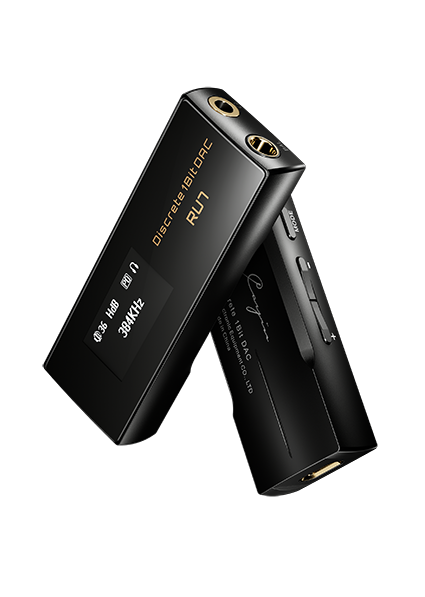
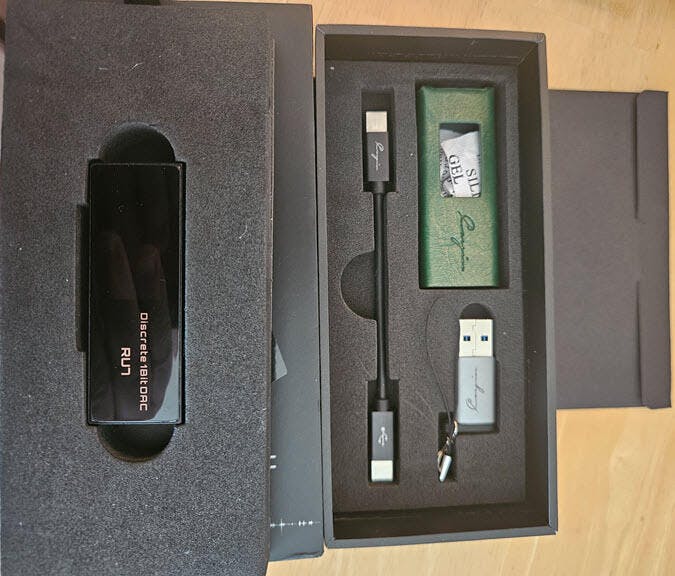
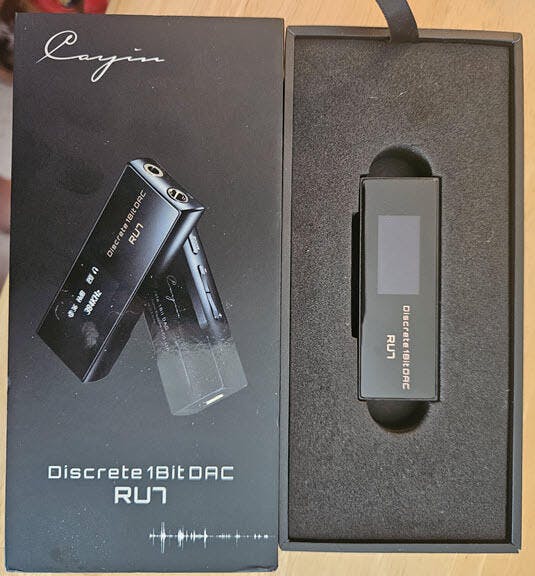
Cayin RU7 1-Bit Resistor Network Dongle DAC /Amp


When the jack stopped working on my wm1a I wanted something small but still with natural musical timbre. I had the W4, which was very resolving and great in its own way. I decided to try the ru7. I think it's great and has the kind of sound I was looking for. It really is a kind of synthesis in sound between the w4 and wm1a.
I typically use this connected to my iPad. Sound is comparable to my desktop DAC. Highly recommend this Dongle.
This DAC makes every song come alive with clear vocals, bass, mids, highs.
With some phones PO isnt enough like my samsung s23 ultra, so you need to change to LO output and then it expands this wide soundstage with amazing details and bass.
But with Ipads for example it needs to be switched to PO or else your Iems or headphones will blast your ear drums.
The Cayin RU7 has added an entirely new dimension to my commutes. I formerly listened to largely news talk podcasts, largely due to the dismal sound of Bluetooth precluding serious listening. But The RU7 completely replaces the Android audio system with an exceptionally well-engineered and constructed miniature DAC with a very clean and powerful analog amplifier section.
This is a DSD transcoder, rather than a simple DAC, Cayin feels that the DSD output is superior to linear PCM. I cannot argue with the results. The sound is as analog as an R2R but retains the resolution of multibit conversion. The sound is as close to a high end R2R as I've heard.
The downside of this performance is that the RU7 will murder your phone's battery in cold blood, but you can adjust the settings to mitigate the power draw. The bit rate settings are key. My almost new sample was already set at DSD256 which is the highest resolution and the most processing which requires more power. Adjusting the bit rate to 128 or 64 will help with battery life.
The bitrate settings are also useful in tuning the sound of the RU7, with the higher settings being the smoothest sounding, but often a bit too unengaging. Lowering the bit rate will help in that instance, increasing detail at the cost of some smoothness. Different settings will suit different tastes and genres. I use DSD128 most of the time as I find it the best balanced, but experiment to find your ideal setting.
The unit does run quite warm at times, no surprise given the hundreds of discrete resistors and components, but it is never uncomfortable to touch. This is a great sounding dongle that shows you just what one of the world's best tube amp makers can do in the dongle market. Best sounding dongle DAC I've heard and well worth the price.
I have been an audio junkie for as long as I can remember. I have watched components get smaller and simply better when it comes to sound reproduction.
I had read about the RU6 and almost bought it but then I read the RU7 was coming so I waited as I read the RU6 just sucked battery power like crazy.
I have a plethora of desktop and Bluetooth dongles but most of them are what you find on Amazon and work pretty well for what I need them to do.
I decided to "upgrade" to the RU7 so I can use it with my PC and my phone plus, I wanted a bit of a "sound upgrade" on my phone. I seem to have become a bit more discerning (spoiled) when it comes to sound reproduction since my desktop DAC/AMPs are pretty decent. I wanted something portable, sounded really good, and just easier to move around.
The RU7 sound is just crazy good for how small it is. I can plug it into my phone then my PC/Laptop and so forth. The sound is just amazing for the size. It rivals my desktop DAC/AMPs for under 500.00. No joke. What I have been noticing is I am using this little guy more as a desktop replacement. It's just too convenient. I put on a pair of IEMs (or headphones) and just listen to my music and of course, Teams calls if it's on my work laptop. If I need to move it to another system, or my phone, I simply unplug it from one and plug it into the other.
From a sound perspective, it's just really good. The bass, mids, and treble are all done very well for something that fits into your hand. Like, surprisingly good. I love the screen. It has balanced and 3.5. It has drivers for my laptops and desktops and it didn't break the bank.
Some of you might be wondering about the battery draw and I was concerned about that as well. It does draw power from the device. My laptops are almost always plugged in but my phone is not. I have a newer phone and I had it running last week for about 2 hours off my phone, plugged into the balanced port. I was streaming music and noticed, after about 2 hours, that my phone was down 13% from a full charge. So, yeah...something to pay attention to. If you are playing music "locally" from your device you might get less of a draw from the battery.
Open Box. I bought the open box version from Music Teck and as always it shipped fast and looked good as new when I got it. Andrew and his team always answer any questions I have and do a great job when it comes to support. I wish I could afford some of the higher-end stuff from Music Teck but, when I have the opportunity (and the money) I head to Music Teck first. Just a great company to buy from.
Overall, the RU7 was what I was looking for. I have a terrific DAC/AMP that's portable, sounds fantastic, and can be moved around my devices with no issues at all. With how good these dongles are becoming, I wonder just how good the next generation of dongles will be. Do they really replace these large desktops setups? Guess we're all about to find out. For now, I'm just going to enjoy the RU7. What a great dongle.
The A&O Omega is a beautiful piece of art. The design, the premium drivers, the cable…all top notch. In today’s day and age, an IEM this special under $3k is significant. Before I get too far into this, it is best to throw a neutral/natural source at the Omega. Something overly warm will leave you missing the higher-end technicalities that it can produce. While it doesn’t HAVE to have a lot of power, something that gives plenty of headroom will benefit the Omega, and your listening enjoyment. Basically, just remember that synergy is king…doesn’t always have to be the most expensive source kit to get the most out of a higher end IEM.
The tonality is full, with a warm tilt. I hear no edginess or sibilance regardless of where the switches are. The bass is just spectacular. If you, like me, had a romantic inclination towards something like the Legend X (or Evo), this is a wonderful upgrade from that general category of sound signature. It evokes the same emotion to me as the X did back in the day. I’ve had the chance to trade with friends a couple of times and just can’t imagine enjoying anything more without breaking my bank with the Fulgrim. Don’t hesitate to give the Omega a try.
When the jack stopped working on my wm1a I wanted something small but still with natural musical timbre. I had the W4, which was very resolving and great in its own way. I decided to try the ru7. I think it's great and has the kind of sound I was looking for. It really is a kind of synthesis in sound between the w4 and wm1a.
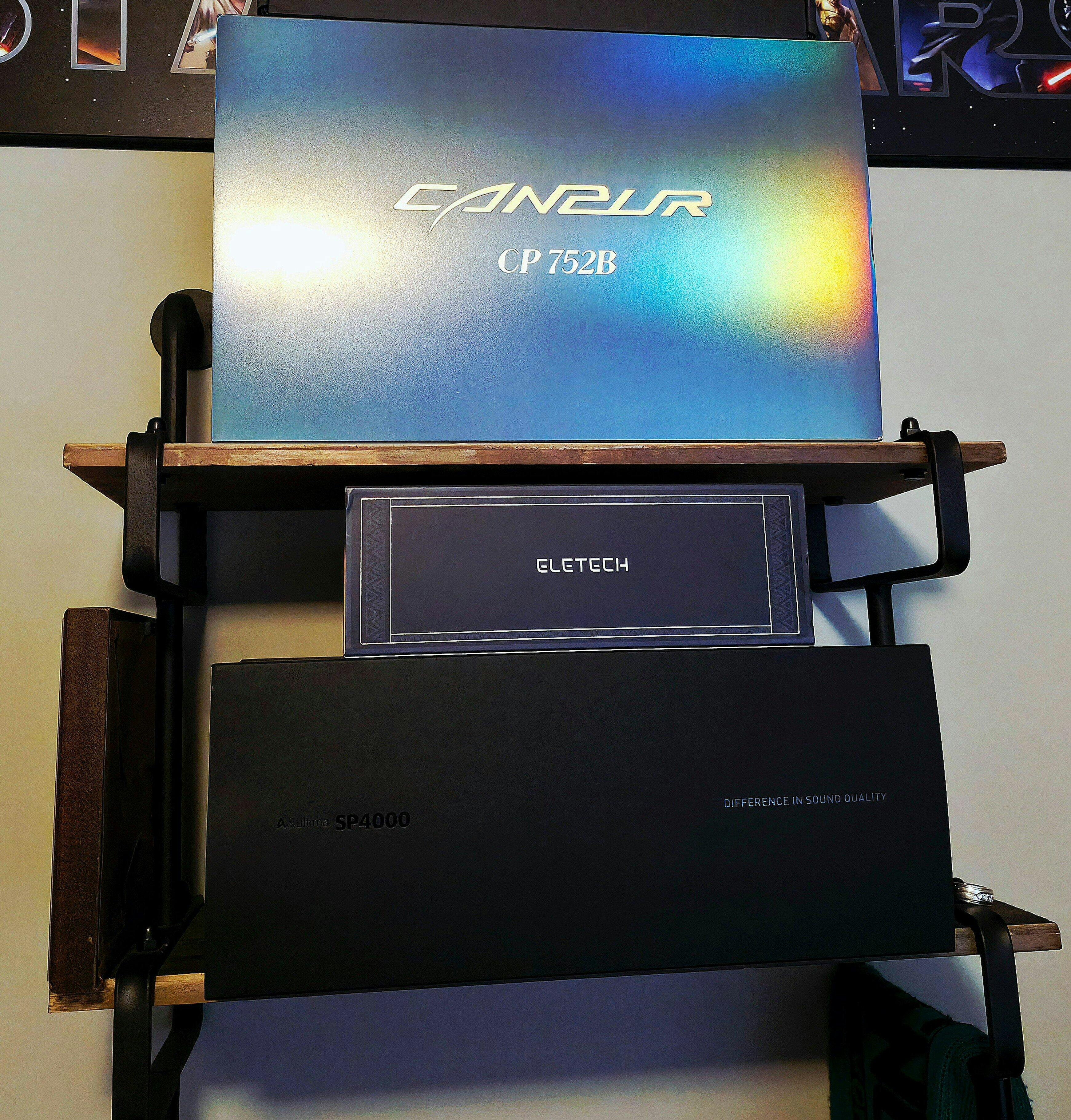
The Canpur CP752B is nothing short of a revelation in the "summit-fi" landscape, effectively redefining what a flagship multiverse-driver IEM can do. The first thing that grabs you is the sheer scale of the soundstage—it is genuinely holographic. Where other IEMs might give you width, the CP752B uses its dual bone conduction drivers to create a 3D bubble that feels less like listening to earphones and more like sitting in a properly treated listening room. The separation is surgical without being sterile; you can pick out every layer of a complex track, yet the drivers—despite being a mix of BA, EST, Planar, and BC—blend with a coherence that is almost impossible to find in other "quadbrid" sets.
Tonally, these strike a brilliant balance that many are calling a refined "W-shape," bringing the best of all worlds. The bass is authoritative and massive, providing that visceral, textured rumble you usually only get from dynamic drivers, yet it retains the lightning-fast speed of balanced armatures. It hits with a weight that provides a solid foundation for the music without bleeding into the mids. Vocals are pushed forward just enough to be intimate and engaging, avoiding that distant "scooped" feeling, while the treble offers that elusive "sparkle without pain"—delivering immense air and micro-detail that extends forever without ever becoming sharp or fatiguing.
Finally, the build and package cement its status as an endgame monitor. The medical-grade resin shells are surprisingly comfortable for the driver count, and the collaboration with Eletech for the stock cable shows Canpur didn’t cut any corners. It is rare to find an IEM that manages to be both a technical monster and musically "fun" at the same time, but the CP752B pulls it off effortlessly. If you are looking for an IEM that competes with (and often wallops) sets costing significantly more, this is absolutely the one to beat.
The Epitome of the "Sophisticated Basshead" Monitor
Sound Signature Overview The Alpha & Omega Fulgrim can be best described as a "sophisticated basshead" audiophile monitor. It offers a masterclass in dynamic control, distinguishing itself by knowing exactly when to exhibit restraint and when to unleash power. Unlike typical bass-heavy IEMs that apply a blanket boost across the spectrum, the Fulgrim respects the mix; if a track demands neutrality, the low end remains disciplined. However, when the composition calls for it, the bass response is authoritative, visceral, and commanding.
Frequency Response Breakdown
Bass (The Foundation): With the stock Aura cable, the tuning exhibits a distinct bias toward the sub-bass region. The quality here is exceptional—highly textured, detailed, and deeply impactful. Crucially, despite the sheer quantity of low-end energy available, the tuning is meticulous; the bass creates a solid floor without ever bleeding into or muddying the lower mid-range.
Mid-Range (The Vocal Presence): Because of the clean separation from the bass, the mids are left uncolored and pristine. Vocals, both male and female, are rendered with clarity and high-resolution detail, ensuring the emotional core of the music is never lost behind the low-end drive.
Treble (The Resolution): The top end is characterized by excellent extension and a palpable sense of "air." Utilizing a configuration of 6 Electrostatic (EST) drivers, the Fulgrim achieves a transient response that is both resolving and authoritative. This technical capability ensures that no matter how thunderous the bass becomes, the treble remains distinct, piercing through the mix to reveal micro-details and atmospheric cues.
Technical Performance & Separation One of the Fulgrim’s standout technical achievements is its frequency separation. The three primary zones—Bass, Mids, and Treble—operate in distinct layers. There is no incoherent overlap or masking; the listener receives a holographic presentation where powerful lows and sparkling highs coexist without competing for acoustic space.
Synergy & Cable Pairing While the stock configuration provides a thrilling ride, those with a sensitivity to high-frequency energy may find the treble energetic. For these listeners, I strongly recommend pairing the Fulgrim with the Astral Acoustics "Luna" upgrade cable. This pairing introduces a subtle warmth that smooths out the sharper edges of the treble response while maintaining the IEM's inherent resolving capabilities, offering a more organic listen without sacrificing detail.
Verdict The Alpha & Omega Fulgrim is a rare beast: a monitor capable of satisfying the cravings of a basshead while maintaining the technical prowess required by a critical listener. Its ability to handle 99% of music genres with agility makes it a versatile endgame solution for those who want power without compromising on clarity.

The rumble in the bass when the bone conduction works properly and the holographic soundstage... I got spooked when I heard a bird chirping behind me and turned back only to find out it was from the song.