
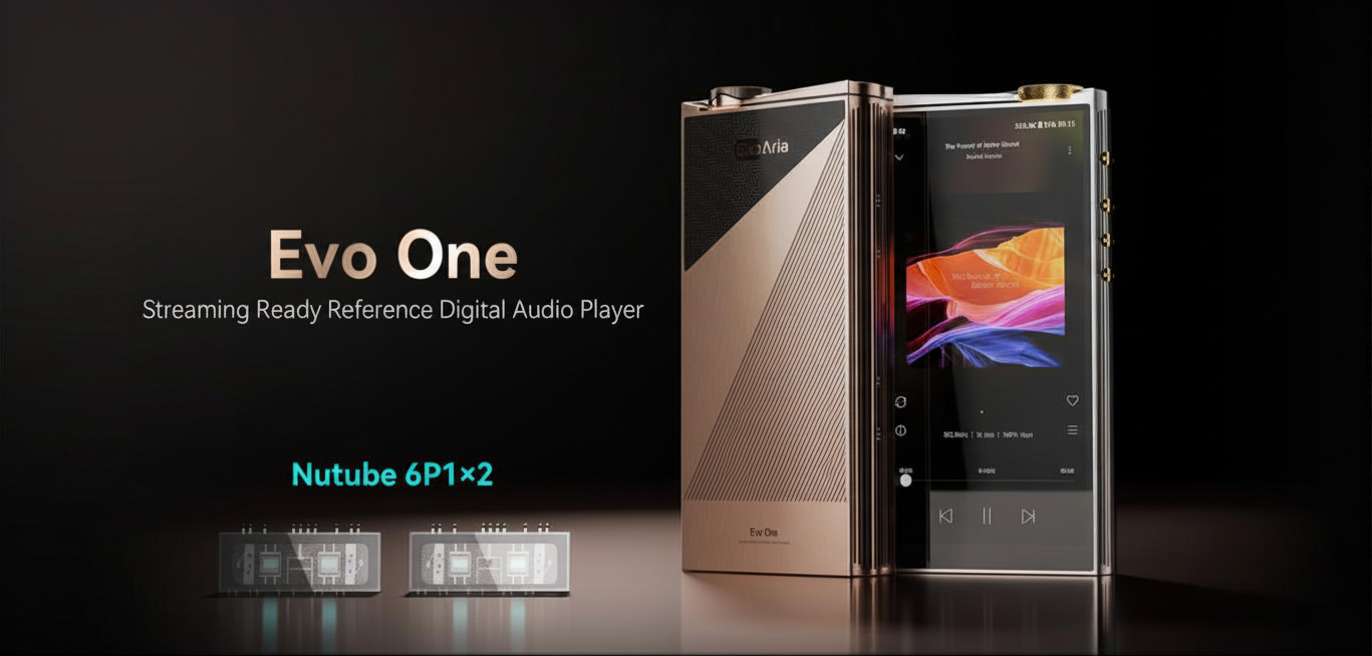
Product: EvoAria Evo One
Hardware: 4*AKM4499EXEQ+2AK4191EQ DAC Chips, Qualcomm QCS8550 Processor with 16GB RAM and 512GB Internal Storage, Triple Analog Audio Architecture with dual Tube timbre available; Switchable NFB and Non-NFB circuits, 10000mAh Battery.
Sound Signature & Tonality Copper: Warm, Lush, Musical, Immersive, more laidback, with focus on the vocal performance and fine details in the mid-range.
Sound Signature & Tonality Titanium: Open, Dynamic, Fast, Engaging, Holographic; with a neutral, balanced sound and ultra-vivid presentations.
Highlights: Rich and versatile tonal configurations with lots of sound-shaping options to fine-tune the sound, powerful amplifier, dark background, zero hiss with sensitive IEMs, stunning build quality and finish, fully open Android system, smartphone-like fast performance, and exceptional sound quality on both versions.
Suitable Genres: Copper—Pop, Jazz, Vocals, Some EDM; Typically, the music genres that need lush mid-range and warm sound will work exceptionally well with the copper version. Titanium—Classical, Rock, Metal, Instrumental Jazz, Some EDM; Typically, the music genres that need excellent soundstage, dynamics, speed, separation and layering will appreciate more of the Ti version.
Sound Impressions:
Both versions deliver outstanding performance, but their tuning philosophies differ fundamentally. It would be far too simplistic to describe them merely as “warmer” versus “more neutral.”
The Copper version presents a more immersive soundstage, with clearly defined boundaries and a strong sense of spatial structure. Its imaging is larger in scale, resulting in a more natural and relaxed listening experience. Compared to the Titanium version and most current flagship DAPs, the Copper version offers noticeably greater note density and body.
Combined with its relatively large and forward imaging, vocal details—such as mouth shape and breath articulation are rendered with exceptional expressiveness. A striking example can be found in Billie Eilish’s “Lovely.” Starting at 2:22, when the arrangement is reduced to just piano and vocals, the Copper version lets you clearly perceive mouth movements and subtle breathing changes.
From a certain perspective, the Evo One Copper can be seen as the culmination of Cayin’s classic tuning philosophy. While earlier Cayin designs were known for their warmth but sometimes lacked impact, the EVO One Copper version successfully supplements this signature with greater authority and impact.
In contrast, the Titanium version adopts a more expansive presentation. Its three-dimensional soundstage extends further in all directions, offering greater width and depth, creating a more transparent, open listening experience. Compared to the Copper version, its image is more focused and finely contoured.
Within this spatial and imaging framework, the Titanium version delivers a listening experience characterized by a large soundstage, high clarity, strong separation, and well-defined layering. What impressed me most, however, is its exceptional dynamics with instant response and fast transients.
For reference, I used “Lingus” by Snarky Puppy. As a live jazz fusion recording, the Titanium version delivers almost astonishing instrument separation and layering: the front-row synthesizers and brass, the centrally placed drums and supporting keyboards, and the bass and guitars in the rear are all presented with remarkable clarity.
At the moment when the synthesizer solo ends around the eight-minute mark, followed by the drum break and the brass entry, the Titanium version does not sound like a hot knife slicing through butter. Instead, it resembles the explosive burst of juice from a freshly squeezed lemon—vivid, energetic, and impactful.
Overall, the Titanium version offers a more modern and expressive sound. While being bold and expensive, it maintains rigorous control over detail and layering, firmly positioning itself as a true top-tier, high-performance source.
vs N30LE
EVO One on the paper offers more advanced DAC chips and sound architecture, as well as faster Android performance thanks to the next-gen Qualcomm processor. It provides users with more timbre settings to fine-tune the sound to their own preferences. In terms of sound, both versions of Evo One offer better clarity, a darker background, and a more resolving sound overall. If you truly love the sound signature of the N30LE and are seeking a direct upgrade, you might lean toward the Copper version a bit more. However, if you are looking for a new sound experience, the Titanium version could be more exciting.
Q&A
1. What is the power output rating on Evo One?
--Up to 1300mw@32ohm with 4.4mm balanced output.
2. Is the difference between the EvoAria One Copper and Titanium versions comparable to the tuning difference between the N30LE’s Classic tube mode and Modern tube mode?
-- No. First, the Evo One also has a different tube timbre across both versions. I would say the differences between Ti and Cu are also related to the soundstage and dynamics, not just timbre. Subjectively speaking, I think the difference between these two versions is more significant than the tube settings.
3. How do they compare to other Android DAPs?
-- This is a very subjective question. To my own ears, Evo One is the best-sounding Android DAP I have heard. The technical specs and audio architecture are the most complex I have ever seen in a DAP. EvoAria will unveil more technical details about these two players. I am sure you will be shocked just like me.
4. Does Evo One support desktop mode?
-- With the new firmware, it now has this function activated.
Share:
EarAcoustic VSA-PM Crown Impression
EarAcoustic Audio Mix9